Jim's Corner Blog

Hickson Compact Galaxy Groups

As everyone knows, my unpublished book, Cosmic Duets, addressed deep sky objects where two or more galaxies or star clusters could be seen in one telescopic field of view.

Everyone is familiar with the Messier and NGC catalogs of deep sky objects.,

A very special catalog features 100 catalogued groups of galaxies called the Hickson Catalog of Compact Galaxy Groups. A Hickson Compact Group is a collection of galaxies cataloged and published by Paul Hickson in 1982.

Dr. Paul Hickson is an astronomer and professor of Astronomy and Astrophysics at the the University of British Columbia. The catalog and list of compact galaxy groups that bears his name is unique in the astronomy world and is comprised of 100 galaxy groups, with each group meeting the definition of a Cosmic Duet. This chapter is just a sampling of the 100 Hickson compact galaxy groups that can be viewed in a single eyepiece field. The full list of the Hickson catalog is provided as an appendix in this book.

In a general sense, galaxy groups are divided into two categories: loose galaxy groups and compact galaxy groups. Loose groups are roughly defined by immense distances that exist between the galaxies, with the distances between galaxies far greater than the size of each galaxy. Compact groups are galaxies whose distance between each member is equal to or less than the size of each galaxy itself.

The Hickson definition of compact groups of galaxies is as follows:

“By “compact group”, we mean a small, relatively isolated, system of typically four or five galaxies in close proximity to one another. Such groups do not necessarily form a distinct class, but may instead be extreme examples of systems having a range of galaxy density and population. Because of this, the properties of the groups in any particular sample may be strongly influenced by the criteria used to define the sample. The early surveys used qualitative criteria that, while successful in finding many interesting individual objects, do not easily allow one to draw broad conclusions about the groups as a whole. Thus, the focus in recent years has been on samples selected using specific, quantitative, criteria. These criteria define the minimum number and magnitude range of the galaxies, and also consider the galaxy spatial distribution.”

“Most compact groups contain a high fraction of galaxies having morphological or kinematical peculiarities, nuclear radio and infrared emission, and starburst or active galactic nuclei (AGN) activity. They contain large quantities of diffuse gas and are dynamically dominated by dark matter. They most likely form as subsystems within looser associations and evolve by gravitational processes. Strong galaxy interactions result and merging is expected to lead to the ultimate demise of the group. Compact groups are surprisingly numerous, and may play a significant role in galaxy evolution.”

A Hickson Compact Group is a collection of four or five gravitational bound galaxies in close physical proximity to one another, published in a list of 100 groupings of closely associated galaxies in proximity of one another. The Hickson catalog 110 groups contain a total galaxy count of 462. These compact galaxy groups comprise of galaxies and their large populations of stars, large quantities of diffuse gas, and are dominated by dark matter. Strong galaxy interactions result with the formation of one large elliptical galaxy forming as the compact galaxy group merges together.

Hickson groups are among the densest concentrations of galaxies known, comparable to the centers of rich galaxy clusters. Compact groups are undergoing intense study to gain knowledge of galaxy interactions and mergers.

Astronomers believe compact groups are relatively short lived entities that form via mergers of galaxies within loose subsystems and groupings. Simulations predict that this merging of the group members should proceed rapidly within a period of one billion years. Hickson groups are therefore snapshots at various stages in this merging process. Astronomers believe they may represent an intermediate stage between loose groups and individual galaxies. A better understanding of the nature of Hickson compact groups could help explain galaxy formation on a larger scale in the early Universe. Compact groups are surprisingly numerous, and may play a significant role in galaxy evolution.

Paul Hickson used a selection process that chose systems of four or more galaxies whose magnitudes differ by less than 3.0. Hickson defined a compactness criterion and an isolation criterion to assure all members of the group were together and reject distant non-member galaxies positioned along the line-of-sight. Even with a working set of selection criteria, the original 1982 catalog contained a few mis-identifications, such as compact galaxies mistaken for stars, and marginal violations of the isolation criteria. Revisions were made in 1989.

The Hickson catalog has stimulated the astronomical community to conducting a large number of studies covering subjects such as the dynamic properties, structure, morphology, physical nature, and cosmological implications of compact galaxy groups.

The velocities measured for galaxies in compact groups are in the neighborhood of approximately 200 km/s, making these environments highly conducive to interactions and mergers between galaxies. The reasons for the formation of compact groups is unknown, as the close proximity of the galaxies means that they should merge into a single galaxy in a short time period, leaving only a fossil group. The implication is that compact galaxy groups are short-lived, and should be extremely rare. Instead, the Hickson catalog identifies a significant number of compact groups.

Astronomers have proposed two ideas to explain the existence of of a high number of compact groups:

This is the final evolutionary phase of all galaxy groups. It is then possible that as one compact group merges to form a fossil group galaxy, somewhere another group is entering the compact phase. This would maintain the overall number of compact groups observed.

Compact groups are more stable against mergers than previously believed. This could result from their being dominated by a single, large halo of dark matter.

Clearly, Paul Hickson and his Compact Galaxy Group catalog has provided impetus to the astronomy community for further research. A survey of studies completed and ongoing concerning Hickson Compact Galaxy Groups include:

1. The Relation between Galaxy Activity and the Dynamics of Compact Groups of Galaxies
2. Globular Clusters around Galaxies in Groups
3. Effects of Interaction-induced Activities in Hickson Compact Groups: CO and Far-Infrared Study
4. Structural and Dynamical Analysis of the Hickson Compact Groups
5. Redshift Survey of Galaxies around a Selected Sample of Compact Groups
6. Dynamic properties of compact groups of galaxies
7. A photometric catalog of compact groups of galaxies
8. Neutral hydrogen in compact groups of galaxies

A few of the brighter Hickson compact galaxy groups are observable by 8” telescopes. Most are accessible by either Dobsonians, Newtonians or SCTs with apertures 12” or larger, or by professional telescopes 24” and larger.

Future Jim’s Corner articles will highlight Hickson Compact Galaxy Groups that can be seen by our own backyard telescope.
Jim's Corner Blog

Musings of a Backyard Astronomer

A Historical View of Telescopes

From a historical viewpoint, today’s commercially available telescopes and eyepieces are technological marvels that the great astronomers of history would have loved using. Who knows what further discoveries that William Herschel or Charles Messier would have made with today’s high quality and sophisticated telescopes and wide field eyepieces.

Charles Messier was a French astronomer of the middle to late 1700’s to early 1800’s, who during his lifetime was more noted as a comet hunter than a deep sky observer. As a result of stumbling upon diffuse “fuzzy” objects that did not move in the sky, Messier, the comet hunter, began compiling a list of fixed diffuse objects in the night sky which could be mistaken for comets. Ironically, in today’s world, Charles Messier is best remembered for his Messier catalog of over 110 deep sky objects rather than for his 13 comets that were discovered during his lifetime.

Messier’s favorite instrument was a 7.5” aperture Gregorian reflector with a 3 foot focal length, with a fixed magnification of 104x. With its speculum metal mirrors, it has been calculated that the effective aperture of this instrument was equivalent to a 3.5-inch refractor. Even worse was the situation for the old 8-inch Newtonian reflector he occasionally used, which again was equipped with speculum mirrors and could only achieve the performance of a modern 2.5” refractor. Later he preferred to use several 3.5” achromatic refractors, with focal lengths of about 3.5 feet, and magnifying 120 times. He selected to use these scopes because they were the most easily accessible instruments for him. All of Messier’s telescopes appeared to have fixed magnifications. Apparently, telescopes of his time did not have interchangeable eyepieces.
All of Messier’s instruments are not as capable as a modern 4” refractor or 8” Schmidt-Cassegrain telescope. Backyard astronomers of today can observe all the objects of the Messier catalog using a 3” or 4” refractor in dark skies.

The story of William Herschel, his sister Caroline, and his son John, and their contributions to the science of astronomy is well documented. Sir William Herschel, born in Germany as Frederich Wilhelm Herschel in 1738, escaped the French occupation of Hanover, Germany and immigrated to England in 1757. A music teacher by trade, he became obsessed with astronomy. Telescopes were not a common place item in England of the 1700’s, so Herschel resolved to learn how to build his own. With his sister Caroline helping, William Herschel began experimenting with grinding mirrors and building reflecting telescopes.

Using innovations, such as the parabolic mirror and a new reflective coating alloy that used an increased mixture of copper in its formulation, Herschel built his first telescope, a 6” aperture with a 7-foot focal length. This initial foray into telescope making was easily capable of seeing Saturn’s rings.

But William knew he could build a bigger mirror, and followed that with a telescope with a mirror diameter of 9 inches. As the mirror size increased, so did the focal length of the telescope, with a focal length growing to 10 feet in length.

His next instrument proved to be his life-long favorite telescope. An 18” aperture with a focal length of 30′, an extremely long instrument by today’s standards. It took him three tries before successfully completing the fabrication of this 18” mirror, with the first attempt ending with a cracked mirror and the second with a molten metal mess.
He went on to complete the construction of a massive 48” instrument, with a focal length of 40 feet! Although certainly the greatest light gathering could be achieved with this instrument, it proved to be very cumbersome to operate, requiring at least two assistants to operate the massive telescope. This telescope and the 18” telescope were not of the commonly accepted Newtonian reflector design. Herschel tilted the primary mirror so that the focus would occur slightly to the side of the telescope. The observer had to be on a platform and lean over the telescope to see the image. This meant that the difficult-to-make-flat diagonal normally used in a Newtonian design could be eliminated. In the case of the 48”, it meant that Herschel was hanging precariously over the end of the telescope tube as much as 40 feet in the air! Few “Herschelian” telescopes exist today, and their design has been left to amateur telescope makers to attempt the challenge of building.
With these telescopes, William Herschel was able to discover the planet Uranus. He and his sister Caroline went onto discover over 2,500 deep sky objects and 848 double stars.
Telescope technology has advanced far beyond the equipment that Messier and Herschel used. Modern telescopes, with advanced telescope optics, advanced coatings, modern eyepiece designs, and the mechanical and electronic innovations of telescope mounting systems, can out-perform any of the classic telescopes of Messier’s or Herschel’s era. The average backyard astronomer with today’s high quality 4” refractor, 8” Schmidt-Cassegrain, or 10” Dobsonian can, with dark skies and due diligence, observe all of Messier’s and most of Herschel’s discoveries.

Jim's Corner Blog

The Leviathan of Parsonstown

M51 was discovered by Charles Messier on October 13, 1773. Messier apparently recognized only the larger portion. It was left to Pierre Méchain on March 21, 1781 to recognize the smaller portion. Messier described it as “very faint nebula, without stars”. Mechain then reported it as “It is double, each has a bright center, which are separated 4’35”. The two “atmospheres” touch each other, the one is even fainter than the other.” Hence M51 is comprised of M51a and M51b, and has two NGC identifications, NGC 5194 and NGC 5195.

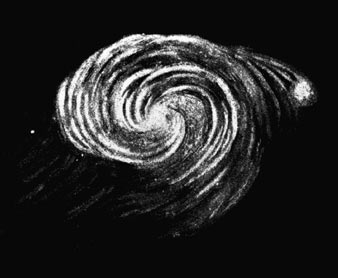
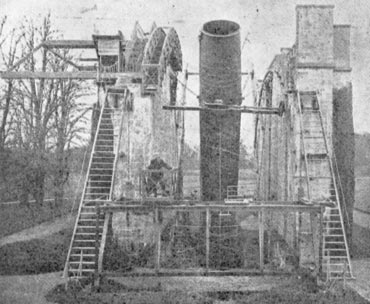
It was not until William Parsons, 3rd Earl of Rosse, using the famous 72” speculum reflector The Leviathan of Parsonstown at Birr Castle Ireland , observed and drew the now recognizable spiral structure of M51.

William Parsons, 3rd Earl of Rosse sketch of the spiral structure of M51

The 72-inch Leviathan telescope, still regarded as the largest amateur telescope in history, replaced a 36-inch telescope that Parsons had built previously. Parsons had to invent many of the techniques he used for constructing the Leviathan, both because its size was without precedent and because earlier telescope builders had guarded their secrets or had simply failed to publish their methods. The Leviathan of Parsonstown was considered the scientific, technical, and architectural achievement of its time, and images of it were circulated widely within the British commonwealth. Building of the Leviathan began in 1842 and it was first used in 1845. It was the world’s largest telescope, in terms of aperture size, until the early 20th century when the building of the 100-inch Hooker telescope at Mt. Wilson ascended to the throne of World’s Largest Telescope. William Parson was the last amateur astronomer to build and own the world’s largest telescope. Since then the title of world’s largest telescope has gone to instruments built and operated by educational or scientific institutions.

The Leviathan was not a perfect telescope. It was awkwardly mounted and was labor intensive to operate and use. It had a limited alt-az mounting (no clock drive here!) capable of only views 7º to either side of the meridian. It used a speculum mirror that tarnished easily. As a result, two speculum mirrors were created, so that one could be used for observations while an army of men on a monthly basis would disassemble the telescope, change out the mirrors, realign the newly installed optics while re-polishing the other mirror.

The poor Irish weather often interfered with the Leviathan’s operational use. But when the weather was good, William Parsons made scientific history with his Leviathan of Parsonstown.

The largest amateur telescope today is a 70-inch Dobsonian, constructed from a U.S. Government surplus spy satellite mirror and parts from Lowe’s and Home Depot, built by Mike Clements and currently housed in the Salt Lake City area of Utah.

Jim's Corner Blog

Hickson groups

Last month’s Jim’s Corner featured the introduction ofHickson Catalog of Compact Galaxy Groups.

Most of these Hickson groups are difficult, if not impossible to locate and observe with most backyard telescopes. Except NGC 3190 Group aka Hickson Compact Group 44

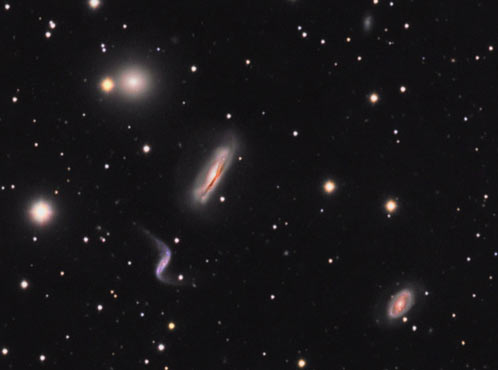
NGC 3190 Group aka Hickson Compact Group 44 (Jon Talbot)

NGC 3190
Alternate: Hickson Compact Group 44
Leo
RA 10h 18 m 05.6 s
Dec +21º 49′ 58”
Magnitude 11.1

NGC 3190 Group
Alternate: Hickson Compact Group 44, including NGC 3185, NGC 3187, NGC 3193
Leo
RA 22h 36 m 20.4 s
Dec +33º 59′ 06”
Magnitude 16.7

NGC 3190 was discovered by William Herschel in 1784.

The Hickson Compact Group 44 group of galaxies lies somewhere between 60 to 90 million light years away from Earth. The group includes NGC 3190, which is a magnitude 11.1 galaxy with a prominent dust lane. The elliptical galaxy NGC 3193 is slightly brighter at magnitude 10.8. NGC 3187 is at magnitude 14.0. The barred spiral NGC 3185 is at magnitude 12.0. There many other very faint galaxies tucked away in the image. Both NGC 3190 and NGC 3185 have a faint halo of stars surrounding each galaxy.

NGC 3190 is retreating from Earth at roughly 1271 kilometers per second. NGC 3190 shows signs of gravitational interaction with its fellow compact group members with its dust lane warped on the side nearer to NGC 3187. There is also a very subtle smudge of light between NGC 3190 and NGC 3193, which seems to be a bridge of stars being shared between the two galaxies.
This group of galaxies was observed in the my 11” aperture SCT comfortably. A dark, moonless and light-pollution-less night is needed. Make sure your eyes are fully dark adapted. The November 2017 issue of Sky and Telescope magazine, in its article on Hickson groups offered that Hickson Compact Group 44 could be seen with an 8” aperture and was the easiest of the Hickson groups to be observed.

Jim's Corner Blog

Introducing the Arp Atlas of Peculiar Galaxies

In 1966, astronomer Halton Arp published a catalog of 338 galaxies entitled Atlas of Peculiar Galaxies. The main goal of the catalog was to present astro-photographs of many different kinds of peculiar structures of galaxies found among the various sky surveys. The reason why galaxies formed into spiral or elliptical shapes was not well understood, and he hoped that by publishing the atlas would stimulate the astronomy community into further study. He perceived peculiar galaxies as small “experiments” that astronomers could use to understand the physical processes that distort spiral or elliptical galaxies. With this atlas, astronomers had a focus group of peculiar galaxies that could be studied in detail. The atlas is a sampling of peculiar galaxies in the sky, each providing examples of the different phenomena as observed in galaxies.

Dr. Halton Arp received his Bachelors degree from Harvard College in 1949 and his Ph.D. From the California Institute of Technology in 1953. For 28 years he was staff astronomer at both the Mt. Palomar and Mt. Wilson observatories. It was during his tenure that he produced Atlas of Peculiar Galaxies. Arp is also famous for questioning the validity of Doppler redshift as a sole determinator for
extreme distances and that the assumption that high red shift objects have to be very far away, upon which the Big Bang theory and all current cosmology thinking is based.

The peculiar galaxies in the atlas are sorted based on their appearance, because little was known in 1966 about the physical processes that caused the various shapes. The atlas was published with a rational order:

Objects 1–101 are individual peculiar spiral galaxies or spiral galaxies that apparently have small companions.
Objects 102–145 are elliptical and elliptical-like galaxies.
Objects 146–268 are individual or groups of galaxies with neither elliptical nor spiral shapes.
Objects 269–327 are double galaxies.
Objects 332–338 are galaxies that simply do not fit into any of the above categories.

Most of the peculiar galaxies are best known by their Messier, NGC, IC, or other designations, with only a handful of galaxies identifiable by their Arp numbers. Some Arp catalog objects are well known: for example M82 the Cigar Galaxy is Arp 337, and M51 the Whirlpool galaxy is Arp 85.

Jim's Corner Blog

Markarian’s Chain

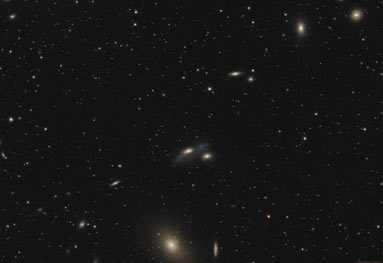
Markarian’s Chain is a group of bright galaxies spread out in a string-like fashion near the center of the Virgo cluster of galaxies. It contains about 12  bright galaxies and many small faint ones.  Figs. 6.6 and 6.7  show the main part of Markarians chain with the galaxy M84 missing and just below the field of view.  Member galaxies include M84, M86, NGC 4477, NGC 4473, NGC 4461, NGC 4458, NGC 4438 and NGC 4435.  Near the center of the image are two interesting galaxies often referred to as the “eyes”.  NGC 4438 is the larger of the two with the other named NGC 4435. Astronomers believe that NGC 4438’s odd shape is the result of a merger between two galaxies. It is also thought that these two galaxies passed very close to each other millions of years ago. The resulting flyby stripped many of the stars from NGC 4435 leaving the oval core. Within photo,  there are over 100 galaxies easily seen. 

Markarian’s Chain (Jon Talbot)

Markarian’s Chain
Alternate: Includes M84, M86, M88, M89, M90, NGC 4478
Virgo
RA 12h 27 m
Dec +13º 10′
Magnitude multiple values

Markarian’s Chain is named after Benjamin E. Markarian, an Armenian astronomer, active in the mid-20th century.  In addition to his identification of the Markarian’s Chain, he is also noted for his special method for identifying galaxies with ultra-violet excess.  During the period of 1965-1980, the Byurakan Observatory conducted a spectral sky survey using Markarian’s method . Markarian published a list of 1500 galaxies with ultra-violet excess, galaxies now known as Markarian galaxies.

Perhaps the richest of Cosmic Duets, the 7 main bright galaxies can be seen with a 4” aperture telescope.  However, to view the dimmer galaxies of Markarian’s Chain, an 8” or larger telescope will bring the true extent of the rich collection of galaxies this region has to offer.  Low or medium-low magnification eyepieces with 60º or greater AFOV is all that is required.

Jim's Corner Blog

M81, M82

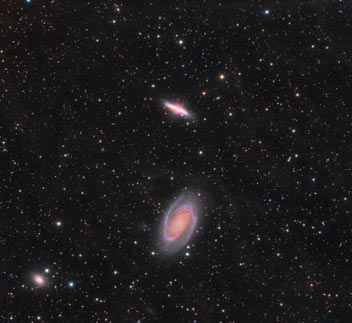
This cosmic duet pair of galaxies is one of the deep sky showpieces that captures the imagination of every backyard astronomer. Easily seen through a 4-inch refractor on a dark moonless night and a favorite target for 8-inch SCT owners, M81 and M82 are separated by only 38′. M81 and M82 can even be seen through 50-mm or greater binoculars from a dark country site.

M81 and M82 with NGC 3077 (Illustration courtesy of Jon Talbot)

M81
Alternate: NGC 3031, Bode’s Galaxy
Ursa Major
RA 9h 55.6 m
Dec +69º 04′
Magnitude 6.9

M82
Alternate: NGC 3034
Ursa Major
RA 9h 55.8 m
Dec +69º 04′
Magnitude 8.4

Historically, both galaxies were first discovered by Johann Elert Bode on December 31, 1774. Bode described M81, now nicknamed Bode’s Galaxy, as a “nebulous patch,” about 0.75 degrees away from M82, which “appears mostly round and has a dense nucleus in the middle.” According to Bode’s historical notes:

I found through the seven-foot telescope, closely above the head of UMa, east near the star d at its ear, two small nebulous patches separated by about 0.75 degrees, the positions of which relative to the neighbored small stars are shown in the tenth figure. The patch Alpha (M81) appears mostly round and has a dense nucleus in the middle. The other, Beta (M82), on the other hand, is very pale and of elongated shape. I could determine the separation of Alpha to d as 2deg 7′, to Rho as 5deg 2′ and to 2 Sigma as 4deg 32′ with some accuracy; Beta was too faint and disappeared from my eyes as soon as I shifted apart the halves of the objective glass.

Pierre Mechain independently recovered both galaxies in August 1779 and reported their positions to his friend Charles Messier. Messier added both galaxies to his catalog after his position measurements on February 9, 1781, and wrote of the cosmic duet:

Nebula (M82) without star, near the preceding [M81]; both are appearing in the same field of the telescope, this one is less distinct than the preceding; its light faint and [it is] elongated: at its extremity is a telescopic star. Seen at Berlin, by M. Bode, on December 31, 1774, and by M. Mechain in the month August 1779.

The pronounced grand-design spiral galaxies M81 and M82 are part of a nearby group called M81. M81 is characterized in the Hubble classification system as a classic Sa-type galaxy, while M82 is an irregular or IO classification. Astronomers believe tens of million years ago, a close encounter occurred between the galaxies M81 and M82. During this near-miss, the larger and more massive M81 has dramatically deformed M82 by gravitational interaction. The encounter has also left traces in the spiral pattern of the brighter and larger galaxy M81, first making it overall more pronounced, and second in the form of the dark linear feature in the nuclear region. The galaxies are still close together, their centers separated by a linear distance of only about 150,000 light years.

M81 is home to over 250 million stars.  M81 is the namesake of the M81 cluster of galaxies, and exhibits a Doppler blue shift, meaning it is approaching the Milky Way instead of receding.

At the center of M81 is a nucleus containing a supermassive black hole that is 15 times the size of the supermassive black hole at the center of the Milky Way.

M81 has two spiral arms containing large quantities of interstellar dust and a number of starburst regions.  Spitzer Space Telescope data have revealed young hot blue stars forming in these regions that are heating the interstellar dust, thus increasing the infrared emissions of  the galaxy.

M82, the Cigar Galaxy, is one of the most interesting galaxies in the Messier catalog, and has undergone extensive study by astronomers.  It is the closest starburst galaxy to Earth and is the prototypical galaxy of this type.  M82 also represents one of the smallest galaxies in the Messier catalog.  Unlike M81, M82 is redshifted and is receding at a rate of 203 km/sec. 

M82 has been long classified as an irregular galaxy.  However, near-infrared observations of M82 within the past two decades have revealed two symmetric spiral arms in the galaxy.  The near-miss encounter with M81 stimulated star-forming activity within M82 that is ten times that of the Milky Way galaxy.

This pair of galaxies can be seen with 12×60 or 20×80 binoculars, and occasionally with 7×50 binoculars by sharp-eyed observers in very dark sites. My f/7.8 4-inch refractor with a wide-field 24-mm eyepiece with an AFOV of 68º yields a magnification of 36x and a true field of 2.24º. This combination easily captures M81 as a bright oval haze and M82 as a slim cigar shape. The 8-inch SCT with the same eyepiece at 83x and a true FOV of 0.98º begins to show a hazy halo of nebulosity around M81, with M82 displaying a nucleus. Higher magnifications will help bring out the detail, and a larger telescope will bring out additional detail.

Jim's Corner Blog

The University of Virginia Clark 26” Telescope

Frank Leavenworth’s discoveries of NGC 1189, NGC 1190, NGC 1191, and NGC 1192 were some of the first using the 26-inch Alvan Clark refractor at the University of Virginia.

The question arises: Why did William and John Herschel miss these galaxies when discovering and observing NGC 1199 nearby?  William Herschel used his favorite 18” reflector for the majority of his observations, although he had a 48” reflector available to him.  The 18” telescope was easier to use.  The Herschel’s larger 48” telescope had a copper mirror that was prone to tarnish and was very cumbersome to use.  The 48” was little used and eventually abandoned , and its remains are part of a garden on his old estate.  Hence, the advantage of a smaller telescope that is easy to use has led to the old amateur adage “the telescope that get used the most sees the most.”  Frank Leavenworth, using the 26” Alvan Clark & Sons refracting telescope at the Leander McCormick Observatory at the University of Virginia in Charlottesville, Virginia had a significant aperture advantage over the 18” reflector used most often by the legendary William and John Herschel.  The additional aperture and greater contrast of the Clark refractor enabled Leavenworth to observe and identify these additional galaxies.

 The Leander McCormick Observatory was constructed using a gift by Mr. McCormick to build one of the largest telescopes in the world.  The observatory was completed and dedicated on Thomas Jefferson’s birthday, on April 13, 1885.  At the time, the 26-inch refractor was the second largest telescope in the world,  tied for that rank with its sister 26-inch Alvan Clark refractor located nearby at the U.S. Naval Observatory in Washington D.C.

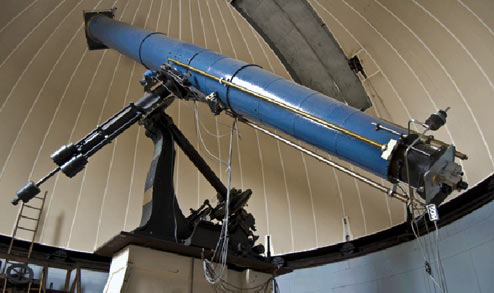
The 26 inch Alvan Clark refractor at the University of Virginia, the instrument could have been completed thirteen years earlier.  Delays to its completion were caused by some financial difficulties that Leander McCrmick had at the time.  By the time these funding issues were resolved, the Clarks had learned of some minor optical issues with the U.S. Naval Observatory instrument.  The Naval Observatory 26 inch had an “object glass ghost” problem.  Alvan Clark ground the inner surfaces of the University of Virginia objective to slightly different radii to avoid this minor optical issue.  So, although the glass blanks for both telescopes were acquired at the same time, the two telescopes are slightly different in manufacture.

The 26-inch Clark refractor at the McCormick Observatory, Univ. of Virginia (U Va archives)

The Leander McCormick Observatory was constructed using a gift by Mr. McCormick to build one of the largest telescopes in the world.  The observatory was completed and dedicated on Thomas Jefferson’s birthday, on April 13, 1885.  At the time, the 26-inch refractor was the second largest telescope in the world,  tied for that rank with its sister 26-inch Alvan Clark refractor located nearby at the U.S. Naval Observatory in Washington D.C.

The 26 inch Alvan Clark refractor at the University of Virginia, the instrument could have been completed thirteen years earlier.  Delays to its completion were caused by some financial difficulties that Leander McCormick had at the time.  By the time these funding issues were resolved, the Clarks had learned of some minor optical issues with the U.S. Naval Observatory instrument.  The Naval Observatory 26 inch had an “object glass ghost” problem.  Alvan Clark ground the inner surfaces of the University of Virginia objective to slightly different radii to avoid this minor optical issue.  So, although the glass blanks for both telescopes were acquired at the same time, the two telescopes are slightly different in manufacture.

Jim's Corner Blog

The Cosmic Distance Ladder

The cosmic distance ladder and how astronomers determine celestial distances is often misunderstood by most amateur astronomers.  The cosmic distance ladder is a succession of different methods used by astronomers to determine distance to deep space objects.,

Basically, there are four different methods used.

  1. The trigonometric parallax method – The most important fundamental distance measurements come from trigonometric parallax. As the Earth orbits the Sun, the position of nearby stars will appear to shift slightly against the more distant background. These shifts are angles in an isosceles triangle, with the distance between the extreme positions of Earth’s orbit around the Sun forming the base of the isosceles triangle and the distance to the star being the equal length sides to complete the triangle.  Precise measurements of angles and simple trigonometry calculations yields the distance to the object.  This method has proven relatively accurate for stars and deep sky objects up to 1,000 light-years.
  • Cepheid Variables Luminosity method –  Understanding the use of Cepheid variables to determine distance is often glossed over in many astronomy books.  The following is an attempt to address the use of Cepheid Variables in distance calculations. By definition, a Cepheid Variable is a star that pulsates radially, varying in both diameter and temperature, thus producing changes in brightness with a well-defined stable period and amplitude.  Or, in another way to describe it, Cepheid Variable stars are intrinsic variables which pulsate in a predictable way. In addition, how often a Cepheid star pulsates is directly related to its luminosity or brightness.  The discovery of the relationship between luminosity and period was made by Henrietta Swan Leavitt, during her tenure as one of the “Harvard Computers”.   Beginning in 1893, Edward Charles Pickering, the Director of the Harvard College Observatory, hired a group of highly educated and skilled women to help him process astronomical data and data analysis using the large number of photographic plates that had been accumulated by the observatory.  The “human computers” became known as the “Harvard Computers”.  Joining Leavitt were Williamina Fleming, Annie Jump Cannon, Antonia Maury, and many more. Two types of Cepheids are used for distance measurement.  The Type I Cepheid variables is also known as the Classical Cepheid.  Type I Cepheids are yellow bright giants and supergiants that undergo pulsations with very regular periods on the order of days to months.  Longer period Type II Cepheids are more luminous, and follow a different luminosity-period curve.  By knowing the period of a Cepheid Variable, the astronomer can refer to the luminosity-period curve to know the intrinsic luminosity of the star, and with the formula of interstellar light absorption calculate the distance.
  • Type 1a Supernova method – Type Ia supernovae are some of the best ways to determine extragalactic distances. Type Ia supernovae occur when a binary white dwarf star begins to accrete matter from its companion star. As the white dwarf gains matter, eventually it reaches its Chandrasekhar Limit of 1.4M, where M is the absolute magnitude.  Once reached, the star becomes unstable and undergoes a runaway nuclear fusion reaction. Because all Type Ia supernovae explode at about the same mass, their absolute magnitudes are all the same. This makes them very useful as standard candles. All Type Ia supernovae have a standard blue and visual magnitude of  -19.3.  Therefore, when observing a Type Ia supernova, if it is possible to determine what its peak magnitude was, then its distance can be calculated.
  • Redshift method – Many distant galaxies are so far away that Cepheid variables and Type 1a supernovas cannot be seen.  The redshift method is a result of Edwin Hubble’s “Hubble’s Law”, which states that the Doppler redshift of a distant galaxy is proportional to how far away the distant galaxy is from earthbound observers.  Hubble’s original value of what is now known as “Hubble’s constant” was extremely overestimated, due to his not knowing there were two types of Cepheid variables. Hubble’s constant has been revised over the years to its current value of 71.0±2.5 km/s/Mpc, with corrections needing to be made to take into account Einstein’s General Theory of Relativity.  Hubble’s Law is mathematically expressed as:

v = HD
v is the recessionalvelocity in km/s
H is Hubble’sconstant
D is the distance from the galaxy to the observer

Books

Astronomy for Older Eyes: A Guide for Aging Backyard Astronomers

Astronomy for Older Eyes - By James Lee Chen
Astronomy for Older Eyes – By James Lee Chen

This book is for the aging amateur astronomy population, including newcomers to astronomy in their retirement and hobbyists who loved peering through a telescope as a child. Whether a novice or an experienced observer, the practice of astronomy differs over the years. This guide will extend the enjoyment of astronomy well into the Golden Years by addressing topics such as eye and overall health issues, recommendations on telescope equipment, and astronomy-related social activities especially suited for seniors.

Many Baby-Boomers reaching retirement age are seeking new activities, and amateur astronomy is a perfect fit as a leisure time activity. Established backyard astronomers who began their love of astronomy in their youth, meanwhile, may face many physical and mental challenges in continuing their lifelong hobby as they age beyond their 55th birthdays. That perfect telescope purchased when they were thirty years old now suddenly at sixty years old feels like an immovable object in the living room. The 20/20 eyesight has given way to reading glasses or bifocals. Treasured eyepieces feel all wrong.  

Growing old is a natural process of life, but astronomy is timeless. With a little knowledge and some lifestyle adjustments, older astronomers can still enjoy backyard observing well into their seventies, eighties and even into their nineties.

If you are interested in purchasing a copy of this book, please consider buying through the links below. For each copy purchased, I will earn a small commission and will use the proceeds to give back to my local astronomy community and fund the production of my next book.

› Buy From Amazon