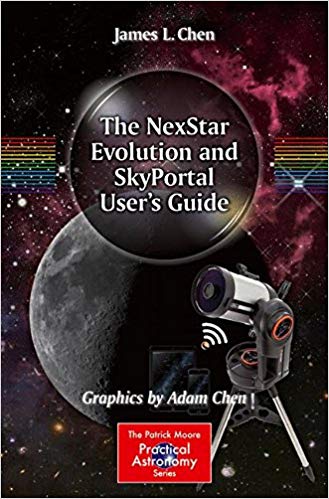
The NexStar Evolution and SkyPortal User’s Guide – By James Lee Chen
This book serves as a comprehensive guide for using a Nexstar Evolution mount with WiFi SkyPortal control, walking the reader through the process for aligning and operating the system from a tablet or smartphone. The next generation Go-To mount from Celestron, this is compatible not only with the Nextstar Evolution but also with older mounts. It is the ideal resource for anyone who owns, or is thinking of owning, a Nexstar Evolution telescope, or adapting their existing Celestron mount. Pros and cons of the system are thoroughly covered with a critical depth that addresses any possible question by users.
Beginning with a brief history of Go-To telescopes and the genesis of this still new technology, the author covers every aspect of the newly expanding capability in observing. This includes the associated Sky Portal smartphone and tablet application, the transition from the original Nexstar GoTo system to the new SkyPortal system, the use of the Sky Portal application with its Sky Safari 4 basic software and Celestron WiFi adaptations, and discussions on the use of SkyPortal application using the Celestron adapter on older Celestron mounts. Comments and recommendations for equipment enable the reader to successfully use and appreciate the new WiFi capability without becoming overwhelmed. Extensively illustrated using actual screenshots from the program interface, this is the only guide to the Nextstar SkyPortal an observer will need.
If you are interested in purchasing a copy of this book, please consider buying through the links below. For each copy purchased, I will earn a small commission and will use the proceeds to give back to my local astronomy community and fund the production of my next book.
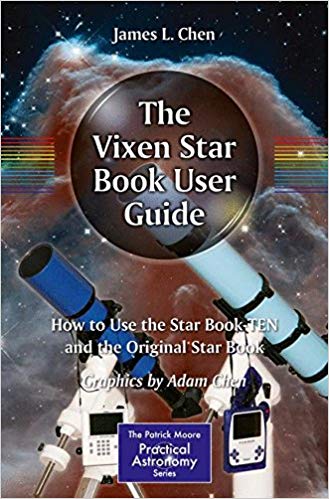
The Vixen Star Book User Guide – By James Lee Chen
This book is for anyone who owns, or is thinking of owning, a Vixen Star Book Ten telescope mount or its predecessor. A revolution in amateur astronomy has occurred in the past decade with the wide availability of high tech, computer-driven, Go-To telescopes. Vixen Optics is leading the way by offering the Star Book Ten system, with its unique star map graphics software. The Star Book Ten is the latest version of computer telescope control using star map graphics as a user interface, first introduced in the original Star Book first offered in 2003.
The increasingly complicated nature of this software means that learning to optimize this program is not straightforward, and yet the resulting views when all features are correctly deployed can be phenomenal. After a short history of computerized Go-To telescopes for the consumer amateur astronomer market, Chen offers a treasury of technical information. His advice, tips, and solutions aid the user in getting the most out of the Star Book Ten system in observing sessions.
If you are interested in purchasing a copy of this book, please consider buying through the links below. For each copy purchased, I will earn a small commission and will use the proceeds to give back to my local astronomy community and fund the production of my next book.
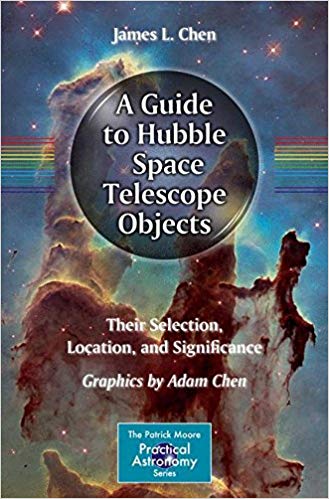
A Guide to the Hubble Space Telescope Objects – By James Lee Chen
From the authors of “How to Find the Apollo Landing Sites,” this is a guide to connecting the view above with the history of recent scientific discoveries from the Hubble Space Telescope. Each selected HST photo is shown with a sky map and a photograph or drawing to illustrate where to find it and how it should appear from a backyard telescope. Here is the casual observer’s chance to locate the deep space objects visually, and appreciate the historic Hubble photos in comparison to what is visible from a backyard telescope. HST objects of all types are addressed, from Messier objects, Caldwell objects, and NGC objects, and are arranged in terms of what can be seen during the seasons. Additionally, the reader is given an historical perspective on the work of Edwin Hubble, while locating and viewing the deep space objects that changed astronomy forever.
Countless people have seen the amazing photographs taken by the Hubble Space Telescope. But how many people can actually point out where in the sky those objects are? Why were these objects chosen to be studied? What discoveries were made from the Hubble Space Telescope photographs? This book is for anyone who wants answers to these questions.
If you are interested in purchasing a copy of this book, please consider buying through the links below. For each copy purchased, I will earn a small commission and will use the proceeds to give back to my local astronomy community and fund the production of my next book.
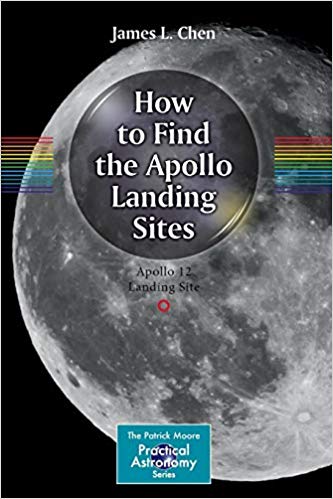
How to Find the Apollo Landing Sites – By James Lee Chen
This book is for anyone who wants to be able to connect the history of lunar exploration to the Moon visible above. It addresses what Apollo equipment and experiments were left behind and what the Apollo landings sites look like now. Each Apollo mission is examined in detail, with photos that progressively zoom-in to guide the reader in locating the Apollo landing sites. Guided by official NASA photographs from the Lunar Reconnaissance Orbiter and the original Apollo missions, the reader can view the Moon with a new appreciation of the accomplishment of landing astronauts on its surface. Countless people have gazed at the Moon in the night sky knowing the successes of the Apollo Program in landing men on the Moon. After the information in this guide, casual and serious observers can actually point out where the Apollo landings occurred as well as knowing why those sites were chosen.
If you are interested in purchasing a copy of this book, please consider buying through the links below. For each copy purchased, I will earn a small commission and will use the proceeds to give back to my local astronomy community and fund the production of my next book.